underwater videographer course | underwater video technique | white balance
White Balance
White balancing video cameras underwater
Everything you shoot is simply light. Radiated light or reflected light
Loss of Color Underwater
Water acts as a filter
Cuts out red spectrum first
Show chart of colour loss with depth
Loss of red with distance as well as depth
Add depth plus distance from subject
Use shot of Padangbai reef to illustrate loss of red with distance/depth
Manual White Balance versus Automatic White Balance
Which cameras allow manual white balance (3CCD etc.)
Which housings all manual white balance
slate
glove
hand
white fin
the reef in general
white or grey
Colour Correction Filters
Internal screw-on
Internal flip
External
Glass or plastic
UR-Pro
pic of UR-Pro
Magic Filters
pic of Magic Filters
Wetpixel thread! - http://wetpixel.com/forums/index.php?showtopic=16970&st=120
Make a decision between trying to make everything look the same as it would if it was lifted to the surface, or accepting that it's blue/green. Nobody is "correct".
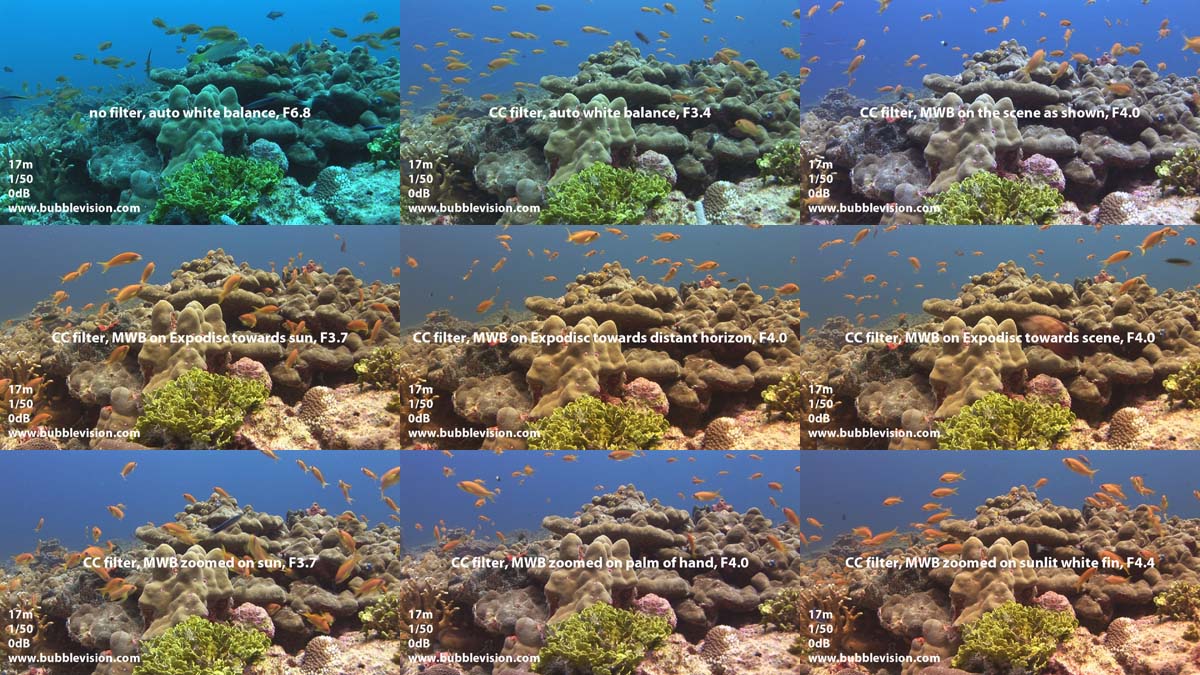
Available Light versus Artificial Light
The human eye and brain "calibrates" itself to an extent to changes in the colour temperature of the ambient light. So in a room filled with warm tungsten lighting the brain compensates for the yellowness and allows us to differentiate the full range of colours in the room. Under fluorescent lighting we compensate for the "cool" light and feel that whites are indeed white and not pale greenish blue. Similarly underwater, although the red has all but gone at depth, my brains can still distinguish the red fish from the blue. Unfortunately cameras do not do this automatically. Under tungsten light everything looks yellowish, under fluorescent light everything looks bluish, and under water everything quickly becomes a washed out monochrome blue/green.
[b]In theory[/b] the result will be a bit warmer with the fin, assuming the slate is closer to the camera.
When trying to understand this stuff, it helps to think of water as a very thick green/blue weakly-coloured filter. It also helps to consider the distance light travels from the light source to your subject, plus the distance that light travels from the subject to your camera after it has reflected off your subject.
The loss of red in light depends on the total distance the light travels. For example if you're shooting with available light (i.e. daylight, not electric lights) the total distance the light travels is the distance from the surface to your white balance surface, plus the distance from that white balance surface to your camera. This is the "water column" that the light travels through. If you're at 20m depth and your fin is 1m further away from your camera than a white slate would be, this means that the light is travelling 21m when using a fin, as opposed to 20m with a slate. i.e. just 5% more which is just about negligible. However if you're at 5m depth then this extra distance is 20% more (6m not 5m) and therefore more significant.
Personally I prefer to white balance on the palm of my hand these days. The result is great and it's convenient i.e. I usually have a good idea where my hand is (unless I'm deeper than 55m on air... then it's debatable).
< back to underwater video technique | white balance | forward to focus >
